Budha Dal Jathedar Lineage: The Unbroken Authority of the Guru Khalsa Panth
The lineage of the Budha Dal traces its sacred origins to the formation of the Akal Sena during the time of Sri Guru Hargobind Sahib Ji. This period marked the institutional foundation of the Sikh martial tradition. Baba Budha Ji, one of the most revered figures in Sikh history, stands at the spiritual root of this lineage. As one of Sri Guru Nanak Dev Ji’s closest disciples and a servant of the first six Sikh Gurus, Baba Budha Ji represents continuity, devotion, and Guru-ordained authority.
When Baba Budha Ji arrived at Gwalior Fort accompanied by Sikh warriors mounted on horseback to welcome Sri Guru Hargobind Sahib Ji, the Sixth Guru was deeply pleased and bestowed a divine boon that established the eternal sanctity of this martial tradition. It is from this sacred legacy that the authority of the Budha Dal Jathedar originates.
Although the Budha Dal was formally institutionalized later, its spiritual command was already active from the times of the Sikh Gurus themselves.
Baba Binod Singh Ji and the Foundation of Budha Dal Leadership
When Sri Guru Gobind Singh Ji dispatched Baba Banda Singh Bahadur to Punjab from Nanded with the Khalsa Panth, Baba Binod Singh Ji was appointed as the Jathedar of the Dal Khalsa, the Khalsa army. Baba Binod Singh Ji was the seventh generation descendant of Sri Guru Angad Dev Ji and had directly served Sri Guru Gobind Singh Ji.
When ideological differences arose between the Nihang Singhs loyal to Sri Guru Gobind Singh Ji and those aligned with Baba Banda Singh Bahadur, Baba Binod Singh Ji led the Nihang Singhs away to preserve the authentic traditions of the Khalsa. This group became known as the Tat Khalsa (the True Khalsa), while the other faction became known as the Bandai Khalsa. After the martyrdom of Baba Banda Singh Bahadur, the Khalsa was reunited once again.
This event firmly establishes Baba Binod Singh Ji as the first Budha Dal Jathedar in lineage, even though the name “Budha Dal” itself was formally adopted later.
Nawab Kapoor Singh and the Naming of Budha Dal
After Baba Binod Singh Ji, Baba Darbara Singh Ji humbly and wisely led the Khalsa Panth. It was under the leadership of Nawab Kapoor Singh that the Khalsa warriors who had continuously served the Gurus were formally institutionalized under the name Budha Dal in 1773.
From this point onward, the Budha Dal became recognized as the supreme martial and spiritual authority within the Khalsa Panth. Giani Slukhan Singh describes this formal process as the official birth of the Budha Dal structure.
Because of this historical authority, the term Shiromani (highest of all) is traditionally applied to Budha Dal.
Budha Dal as the Fifth Takht: Panjwan Takht
The Budha Dal holds the unique position of being the fifth mobile throne of Sikh authority, known as the Panjwan Takht.
The four stationary Takhts are:
- Sri Akaal Takht Sahib
- Takht Sri Patna Sahib
- Takht Sri Kesgarh Sahib
- Takht Sri Hazoor Sahib
Budha Dal functioned as the Chalda Vaheer (moving throne), constantly traveling between historic Sikh shrines to ensure that religious duties were performed correctly and Sikh traditions were preserved. Even today, Budha Dal consists of both a stationary headquarters and a Chalda Vaheer that travels across India, spreading Sikh teachings and maintaining historical Gurdwaras under its supervision.
Supreme Authority of the Budha Dal Jathedar
The supreme authority of the Budha Dal Jathedar was most evident during the time of Akali Baba Phula Singh Ji, who exercised complete religious authority even during the reign of Maharaja Ranjit Singh. When the Maharaja violated Sikh moral codes, Baba Phula Singh Ji ordered corporal punishment upon him, and the king humbly accepted it. This event was witnessed and recorded by several European historians, confirming the independent and supreme authority of the Budha Dal Jathedar.
Nihang Singhs and Control of Takht Sahibs
Giani Kirpal Singh, former SGPC-elected Jathedar of Sri Akaal Takht Sahib, records:
“After the martyrdom of Baba Akali Phula Singh Ji, Baba Hanuman Singh Ji became Jathedar of Budha Dal. After them, Baba Prehlada Singh Ji and Baba Giana Singh Ji served as Jathedars. The head priests at Sri Akaal Takht Sahib, Sri Kesgarh Sahib and Takht Sri Damdama Sahib were Nihang Singhs. Management and control of the Takhts remained in the hands of the Budha Dal Jathedar.”
He further confirms that Budha Dal managed all historic Gurdwaras in Punjab, conducted initiation ceremonies, preserved Sikh customs, and spread Sikh Dharam.
Senior priests at Takht Sri Hazoor Sahib and Takht Sri Patna Sahib were also Nihang Singhs, further validating Budha Dal’s supreme religious authority.
Budha Dal: The Original Khalsa
Sant Nahar Singh Nirmala states:
“Budha Dal is the original Khalsa. Sri Guru Gobind Singh Ji appointed Baba Binod Singh Ji as head of the Khalsa Panth. After him was Baba Darbara Singh Ji and then Nawab Kapoor Singh Ji who named them Budha Dal. They are the Guru Khalsa Panth ordained by the Tenth Guru. Budha Dal is the Shiromani Panth.”
This statement confirms that Budha Dal Jathedar authority is Guru-ordained and predates all modern Sikh institutions.
Budha Dal 96 Crori: Meaning and Authority
The title 96 Crori means the commander of the 960 million Khalsa army that will exist during Khalsa Raj. This sacred title is exclusively reserved for the Budha Dal Jathedar.
Hence:
- Budha Dal 96 Crori represents the supreme commander of the Guru Khalsa Panth.
- The title cannot be used by any other Sikh organization or Jatha.
List of Budha Dal Jathedar (96 Crori)
This is the historically accepted list of Budha Dal Jathedar, preserving unbroken lineage:
1. Jathedar Baba Binod Singh Ji
2. Jathedar Baba Darbara Singh Ji
3. Jathedar Baba Nawab Kapoor Singh Ji
4. Jathedar Baba Jassa Singh Ji Ahluwalia (Sultan-ul-Qaum)
5. Jathedar Akali Baba Naina Singh Ji
6. Jathedar Akali Baba Phula Singh Ji
7. Jathedar Akali Baba Hanuman Singh Ji
8. Jathedar Baba Prehlada Singh Ji
9. Jathedar Baba Giana Singh Ji
10. Jathedar Baba Teja Singh Ji
11. Jathedar Baba Sahib Singh Ji Kaladhari
12. Jathedar Baba Chet Singh Ji
13. Jathedar Baba Santa Singh Ji
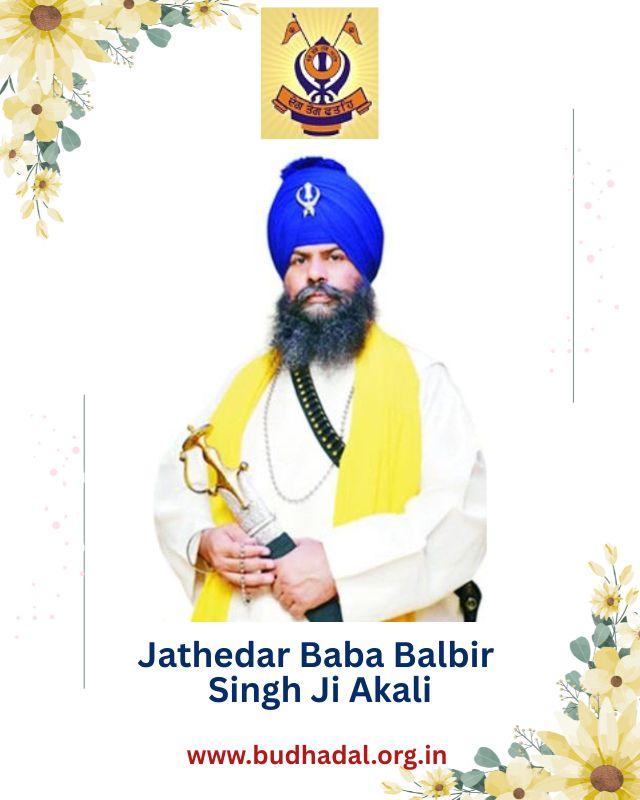
14. Jathedar Baba Balbir Singh Ji Akali (Current Budha Dal Jathedar)
Current Budha Dal Jathedar: Baba Balbir Singh Ji Akali (96 Crori)
The Current Budha Dal Jathedar is Baba Balbir Singh Ji Akali, who bears the sacred title of 96 Crori. In Sikh tradition, the title Budha Dal 96 Crori represents the supreme commander of the Guru Khalsa Panth and is reserved exclusively for the Jathedar of Budha Dal.
Today, the Budha Dal Jathedar now guiding the Panth is Baba Balbir Singh Ji Akali. His leadership continues the unbroken Guru-ordained lineage that began with Baba Binod Singh Ji and has passed through the great warrior-saints of Sikh history.
Budha Dal Jathedar Name in the Present Era
For those seeking the Budha Dal Jathedar name, it is recorded as Jathedar Baba Balbir Singh Ji Akali (96 Crori). He is universally recognized within the Nihang tradition as the spiritual and martial head of Budha Dal.
Baba Balbir Singh Ji and the Budha Dal
Baba Balbir Singh Budha Dal represents the living continuity of the Khalsa’s original authority. Under his guidance, Budha Dal maintains its role as the Panjwan Takht (fifth throne) of Sikh sovereignty, preserving traditional Sikh maryada, martial discipline, and spiritual leadership.
Baba Budha Dal Jathedar and the 96 Crori Title
The term Baba Budha Dal Jathedar refers to the supreme head of the Budha Dal who holds the title of 96 Crori. In the present time, this title belongs to Baba Balbir Singh Ji Akali, making him the recognized bearer of Budha Dal 96 Crori authority.
Budha Dal 96 Crori: Living Authority
The sacred designation Budha Dal 96 Crori symbolizes the divine command over the future Khalsa army of 960 million. This authority today rests with Baba Balbir Singh 96 Crori, whose leadership reflects the timeless sovereignty of the Guru Khalsa Panth.
This blog "Budha Dal Jathedar Lineage: The Unbroken Authority of the Guru Khalsa Panth" was originally published Here.
टिप्पणियाँ
एक टिप्पणी भेजें